You Already Know What to Do
Trust yourself. You’ve got this.
3 min read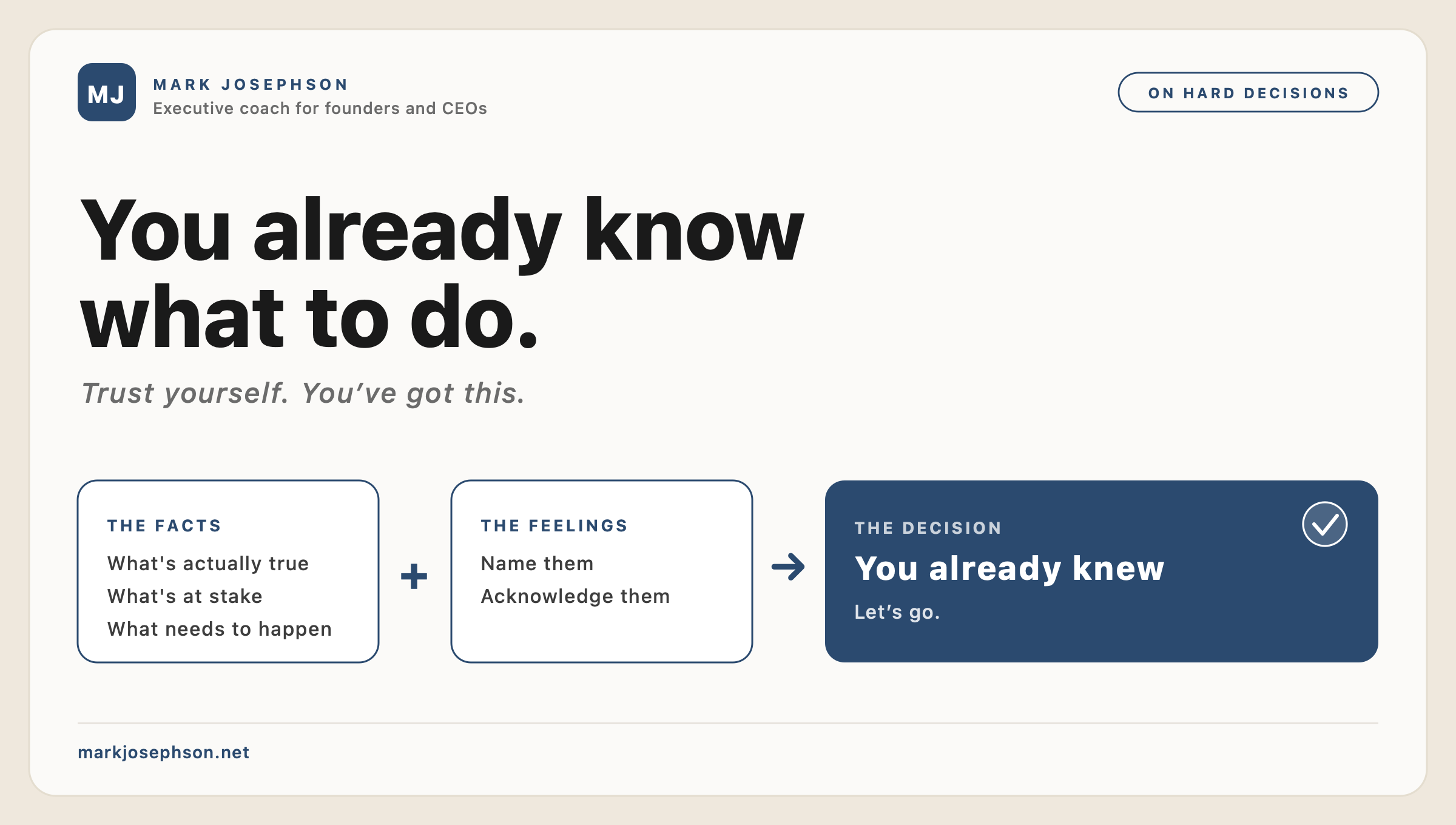
I’ve seen it three times this month, and some version of it comes up almost every week: a founder paralyzed by a decision they already know how to make.
Not confused. Not short on information. Just paralyzed, frozen in front of a call they already knew the answer to.
And every time, somewhere in the conversation, they’d say the exact right thing. Clear as day. The whole decision, fully formed, in their own words. They already knew.
They’d known for a while. They just weren’t doing it.
The gap is not knowledge
When you’re stuck on a hard decision, it’s tempting to think you’re stuck because you don’t have the answer. You almost always do. You know it better than anyone else in the building. What you’re missing isn’t the answer. It’s permission from yourself.
So instead of deciding, you get in your own head. And there are a thousand reasons not to move. How will this person feel? What if I’m wrong? Am I even allowed to make this call? What if the team thinks I’m weak, or that I’ve blown calls before, or that I have no idea what I’m doing?
None of that is the decision. It’s the noise around it. And you can spend weeks in that noise, second-guessing a call you’ve already made.
Two things are tangled: the facts and the feelings
When you’re stuck like this, the first thing we do is pull the two apart.
Have the fact conversation. Then have the feeling conversation. Keep them separate, and keep them black and white. What are the facts? Not the fears, not the maybes. The facts.
Then, separately: what are the feelings? Name them honestly, because they’re real and they’re what’s driving the delay. Just don’t let the feelings pretend to be facts.
Line them up side by side and it usually gets simple fast. The facts point one way. The feelings are the thing holding you back. That’s not a reason to ignore the feelings. It’s a reason to stop confusing them with the decision.
Put dates and numbers on it
The second move is to make it concrete. What is this costing you right now, in real dollars, every week you wait? What has to be true to hit your goals, and by when? Run the math backward from there.
Usually the math makes it clear you have no choice. You don’t have a marketing leader and you need pipeline in ninety days, so you can’t wait a quarter to decide. The wrong hire costs you money and momentum every day they stay. The product window is closing. When you ground it in dates and numbers, in the plain math of your happy customer machine, “I’m not sure yet” becomes “I can’t afford to wait.”
This isn’t about panic. Real urgency comes from seeing the stakes clearly, not from scaring yourself into moving. Once you can see the cost, the decision stops feeling optional.
Get input, then trust yourself
None of this means deciding alone. Get input. Pressure-test it. Talk to the people who will tell you the truth, not the ones who tell you what you want to hear.
But once the input is in, the job is to trust yourself. That’s the job of a CEO: making hard calls with incomplete information and standing behind them. You won’t always be right. You don’t have to be. You have to be able to see it clearly, decide, and move.
And that instinct pulling at you is real. It’s pattern recognition you’ve earned over hundreds of these calls. Call it your spidey sense; it’s usually right. You proved it the moment you said the answer out loud, before you talked yourself out of it. The clarity was never missing. You keep overriding it.
Then move
Separate the facts from the feelings. Get clear on the path. Put a date on it. Then trust yourself and go, before you talk yourself out of it.
You already know what to do. So do it.
You got this. 👊
If you recognize this pattern and want to work through it, let’s talk.
FAQ
Q: What is the main idea behind "You Already Know What to Do"?
A: This post explores you already know what to do from the perspective of an executive coach who has worked with dozens of startup CEOs. It provides practical, direct advice based on real-world experience.
Q: Who should read "You Already Know What to Do"?
A: This post is written for startup founders, CEOs, and senior leaders who want practical guidance on leadership. It's especially relevant for those navigating growth, team dynamics, or strategic decisions.
Q: How can I apply the advice from "You Already Know What to Do"?
A: Start by identifying the one action from this post that resonates most with your current situation. Apply it this week. Leadership changes come from consistent small actions, not overnight transformation.
Get posts like this in your inbox
I write about leadership, decision-making, and building companies. No spam, just ideas that might help you lead better.
No spam. Unsubscribe anytime.